There is a wonderful view from the top of the new bridge, absolutely stunning!
About ten miles to the south is the Chef Pass Bridge, built in 1929.
The Chef Pass Bridge was closed for about a year after Katrina due to issues with soil erosion.
This bridge takes one into the community of Venetian Isles in far east New Orleans.
Another bridge on the road to completion is the I10 Twin Spans. Decimated by Katrina, the new spans were begun in July 2006. The new westbound span is scheduled to open in 2009 with the eastbound span to follow in 2011. The old bridges will then be dismantled.
This view was taken from Highway 11 as it crosses I-10.
Taken last month (March '08), this photo shows the progress being made.
This shot shows how much higher the eastbound span will be from the current bridge
Another bridge being constructed in this area will serve people and horses. It's the long-awaited bridge that crosses Bayou Lacombe on the Tammany Trace. It will be 80 feet long with an eight foot wide pedestrian walkway.
Once this span is complete, the Tammany Trace will offer 36 miles of bike path thru the backroads of St. Tammany Parish. From Slidell to downtown Covingtonm each leg of the trip provides a unique experience far from the hustle and bustle of everyday life.
Bayou Liberty is also getting a new bridge. With a price tag of $6.8 million dollars the bridge will take the place of one that's been in use for many many decades.
Here's a great you tube video on the construction.
From Travelvideo.tv website: By Bea Broda (travelvideo.tv) New Orleans, April 5, 2008: Hurricane Katrina descended on New Orleans on August 29th 2005 – one of the worst years for hurricanes in history. Some 80% of the city was affected by the floodwaters and almost three years later the devastation continues on so many levels. New Orleans needs people to come and help to recover – the tourist economy is vital to its recovery. To date, the government has not come to the plate to help. The first order of business is to try to get people interested in visiting again.
I have personally come to New Orleans as President Elect of SATW (The Society of American Travel Writers) whose Editors Council is holding their annual conference here. After taking a four-hour "Katrina Tour" yesterday and witnessing the enormous breadth of the destruction on so many neighborhoods, it is impossible not to feel very strongly for what this distinctive city has gone through. A panel named "New Orleans Today and Tomorrow: Recovery and Resurgence" addressed issues relating to the city's tourism challenges in the wake of the devastating natural disaster faced in 2005.
The question posed: New Orleans is one of the greatest cities in the US and also the one most in need of the most help - How can we love it back to health?
According to this panel, to date, it’s only the people that have helped with the recovery – not the government at all. It is felt that this is a government level disaster but there has not been adequate response. Things have been so ridiculous that citizens that received some financial assistance to help re-build are expected to claim those funds as income and pay around a third of it back in taxes.
Three panelists weighed in on the issues:
TOURISM
Sandra Shilstone, President and CEO of New Orleans Tourism says they place special emphasis on developing tourism especially in slower times. Tourism employed over 80,000 people before Katrina and contributes a third of the economy. Some 15 million dollars a day in revenue was being lost from conventions being cancelled after the hurricane. War correspondents were coming instead of travel journalists and were giving the rest of the world a frightening picture of the state of things.
A huge initial decision was to continue with the 150th anniversary Mardi Gras, despite the turmoil. A “Thanks America” campaign was launched to everyone that helped during the worst of it. One week after Mardi Gras, New Orleans hosted the SATW Freelance council meeting, targeting some of the most successful travel journalists to help spread the word that New Orleans was still open for business and that the city’s spirit was still alive and well. There was a “Come Fall in Love with New Orleans All Over Again” campaign that had huge media placement across the US.
The latest high spirited commercial stars Jerry Davenport and a cast of thousands. The arts community has returned with vive, starting a bit if a cultural renaissance. The Audobon Nature Institute is opening an Insectarium in June, creating terrific family entertainment.
“Voluntourism” is inspiring, as volunteers come to help mend the devastation. In fact, enrollment is on the rise at the major universities such as Loyola with students that came to help with the rebuilding effort.
Prior to Katrina, annual tourists were 10.1 million and in 2006 that had decreased to 3.7 million people. In 2008, there has been a 90% increase, but certain misperceptions remain. People think the city is still under water and not ready to be visited. The city IS coming back, but there is a need for more leisure tourists to continue the recovery.
SECURITY
Warren J. Riley, Superintendent of the New Orleans Police Department with 27 years in the police force, says: In terms of crime and redevelopment - three precincts were completely destroyed and 5 out of 19 were greatly devastated. 174 officers were hired last year and another 72 this year. Many officers have been living in trailers that are 10 by 25 feet with four people in the same trailer. The criminal justice section was destroyed – people have been working out of trailers and bar rooms, but the system is now operating on all cylinders mainly because there has been such a strong determination to get home. The first two years was very tough, trying to stabilize the situation after such rampant evacuation.
Superintendent Riley feels that the police force of New Orleans handles huge events better than any other in the country. The force is still short with around 170 officers but Riley feels they will fill this in the next year. He hopes to convey that the city is safe to visit and people should feel quite comfortable. Significant strides have been made and there is a focus on tourism areas. Over 800,000 people are handled during Mardi Gras without incident, a fact of which Riley is proud.
Some of the terrible headlines after Katrina were accurate because of the lack of manpower in the police force, but the recruitment efforts have now changed all of that. Undercover officers also patrol some of the major popular areas such as on Bourbon Street. The numbers have increased from 88 officers pre Katrina to 124 assigned to the French Quarter. Like any other large city, there are areas of concern regarding crime. Much crime is very internal and drug related.
There are four hospitals that are capable of handling large crowds in the city, as well as other facilities with in a twenty-minute drive from the city. There is a heightened state of readiness for emergencies since the days prior to 9/11.
THE JAZZ AND HERITAGE FESTIVAL
Quint Davis – Producer and Director of the New Orleans Jazz and Heritage Festival, says they look at the festival as a metaphor for the city – a microcosm of New Orleans. There are around 5000 musicians that participate in a festival, but during Katrina, obviously there was a tremendous shortage. They decided to have it, despite the fact that the population of the whole city was around the size of a typical one-day audience. Huge names agreed to appear for the event and somehow 50 or 60,000 people came. The will of the people to see the festival happen and go on was palpable.
Last year New Orleans was back to around 30,000 rooms and there was more international travel to the jazz festival than there has been since 9/11. There ensued an effort to advertise in national newspapers that resulted not only in a growth on a regional base, but from all over the country and the world. In fact, the numbers even exceeded pre 9/11 numbers.
Jazz Fest is a New Orleans experience – not just a music event. The impact on the city of the Jazz and Heritage Festival is around $285 million dollars. 103 live bands are advertised in today’s paper as playing in the city right now. As you walk down famous streets like Bourbon Street, live music emanates from so many establishments, a pleasure in an era of piped music and DJs. It is expected that this year’s festival will be the largest in history and Davis believes they have not just recovered but are actually moving forward.
Aaron Neville, Santana, Billy Joel, Stevie Wonder, Al Green, Diana Krall, Jimmy Buffet Elvis Costello and Sheryl Crow are some of the names expected to entertain this year.
The success of the Jazz and Heritage Festival is more a testimony that there is a mission to keep the essence of New Orleans alive.
The first weekend of the festival this year is April 25th to 27th, and May 2 to 4 is the last weekend. The New Orleans Wine and Food Experience runs May 21 to 25, 2008.
June 13 – 15 – Creole Tomato Festival June 13 – 15 – Zydeco Music Festival
The city is ready to welcome back the tourists and hopes very much that they won’t stay away, thinking that the city is not capable of handling tourists.
It appears as though it's impossible to stop the people of New Orleans from dancing!
photo from biloxibridge.com "Phenomenal" Biloxi Bridge Completely Open: "After 31 months, one week, and two days, Biloxi and Ocean Springs have been reconnected, by a $338 million concrete marvel. The federal government paid for the replacement roadwork, just like it paid for the $283 million bridge that reconnects Pass Christian and Bay St. Louis."
Click here for before and after images of the Biloxi Bay Bridge from the SunHerald. image from http://mceer.buffalo.edu Katrina's 28-foot storm surge destroyed the Biloxi Bay Bridge, which connected Biloxi to Ocean Springs.
If you look deep enough, you'll find a lot of awareness about this area across the country. Here is one article written by a senior at Whitworth University in Washington State
OPINION: The hurricane of coverage is no more, but New Orleans remains
Maybe it's because the average American has an attention span of eight seconds.
Whatever the reason, "out of sight, out of mind" is probably a fair assessment of the state of New Orleans and the rest of the Gulf Coast affected by Hurricane Katrina.
While media coverage and promises to rebuild were rampant in the first months following the storm, nearly three years later, those promises are still unfulfilled and we've all but forgotten - we being America at large.
Though thoughts of Katrina and its victims are less prevalent today, for six Bonner Leadership Scholars who spent this past Spring Break rebuilding on the Gulf Coast, the reality of Katrina victims' continued devastation will not quickly be forgotten.
Witnessing the influx of refugees in her Texas hometown prompted sophomore Katie Petitt to volunteer in New Orleans.
"I am from Texas and so we got a lot of refugees after Katrina, so the storm was more of a real thing to me than maybe others. [In New Orleans] we saw a lot of devastation and hopelessness. The city is still not rebuilt, and there were countless houses gutted out, rotting, or just turned into rubble by bulldozers," Petitt said in an e-mail interview.
Despite claims of progress, much of New Orleans and the surrounding area remain uninhabitable.
Katrina left 80 percent of New Orleans flooded, took over 1,800 lives and displaced over 800,000 people.
While some have returned to New Orleans, many residents of lower-class neighborhoods lack the means to rebuild and have been permanently displaced. Unlike low-income areas such as the 9th Ward, wealthy neighborhoods such as Lakewood have been reconstructed using private funds.
During the 2008 State of the Union Address, President Bush commended the effort that has gone into rebuilding the Gulf Coast and announced plans to convene the 2008 North American Summit of Canada, Mexico and the United States in New Orleans.
Scheduled for April 21-22, the impending Summit places government leaders in the very place they have been accused of abandoning.
In April 2007, the New Orleans Office of Recovery Management released the Unified New Orleans Plan, which outlined intentions to begin rebuilding throughout 17 "Target Areas," including the Lower 9th Ward.
To date, rebuilding of these areas has yet to commence.
Junior Skye Staley recalled her experiences in New Orleans.
"One of the most poignant memories I have of New Orleans is a sign we passed in the Lower Ninth Ward, the neighborhood literally right next to the area of the levee that broke.
"Nearly three years later, most people have not even returned to the area, and the few houses standing are still in complete disrepair," Staley wrote in an e-mail.
Part of the sign's message read: "We want our country to love us as much as we love our country."
At one point America did love the Gulf Coast.
Within a month after Katrina, American charities raised over $1 billion, according to The Chronicle of Philanthropy.
In recent months, American citizens have proved less charitable, less concerned.
And while the federal government has provided over $144 billion to assist reconstruction, little of that money has made its way to those who need it.
Professor of theatre Rick Hornor accompanied the student volunteers during the Spring Break trip.
"I was stunned at how bad the situation still is. It's interesting to see where the money has gone. The casinos and hotels, those are back. But all along the coast there are still piles of bricks. In between Bay St. Louis and Biloxi you can count on maybe two hands the number of beach front homes. Police departments and the city hall are still in FEMA trailers," Hornor said.
With the third anniversary of Katrina approaching, it would be nice to know we have made progress in returning survivors to a state of normalcy and stability.
It would be nice to know that as a country, we have not forgotten our neighbors. With attention divided between politicians and their intentions for the country, Iraq, healthcare and so on, we must remember to remember those in our own land.
If a national crisis is not met with appropriate concern, what of foreign policy?
No, we can't all rebuild in New Orleans or donate thousands of dollars.
But what we can do is keep talking, keep reading and keep remembering.
Maybe those in charge will take notice if we can make Katrina the "Most Popular" story on Google.com.
It's a start.
Karla Rose is a an opinions columnist and a senior majoring in English. Contact her at karla.rose@whitworthian.com.
Katrina has changed so many lives in huge ways. One such life is Michael Dingler's; pre storm he was close to gaining certification for a legendarily well-paid job as a riverboat pilot . In early 2006, a creeping depression swallowed him completely. He walked away from the job, lost his marriage, left town, spent months driving around out West, searching for, himself. From nola dot com: "I was searching for myself," he says. "At the same time, I was also running from myself, not realizing that, no matter where I ended up, I was still going to be me." So he returned to New Orleans and - at age 34 - he was developing a purpose for his life, a reason to get back on his feet. He gave himself the nickname of "ReX" and started NoLA Rising, a group of art emissaries who post artwork in public places as far and wide across the region as possible.
Now, this group faces a legal challenge from the City of New Orleans, spurred on by the activities of local anti-graffiti crusader Fred "the gray ghost Radtke , a REAL vandal and his group Operation Clean Sweep.
Ashley Morris' friends have worked mega hard and fast to set up a paypal account to help Ashley's wife and three kids cover the costs of his death.
From Humid City's website: A major voice in the New Orleans blogosphere has gone silent, widowing a Rollergirl and orphaning three tiny children. As various local groups prepare a benefit we see major obstacles looming for the family including five figure expenses for the funeral. Please give what you can, even a few dollar here and there can mount up. There are needs that cannot wait on the fund raising events.
Please join the efforts of HumidCity, Defend New Orleans, NOLA Rising, WTUL, Tales of the Cocktail, The Big Easy Rollergirls, The Skull Club, L’Art Noir, and many more as we show the Morris Family what community really means!
Online Donations can be made at Remember Ashley Morris
If you wish to mail a donation make the check out to Hana Morris and send it to:
HumidCity c/o George Williams 5500 Prytania St. PMB #417 New Orleans, LA 70115
I never met Ashley in person, but feel as if I knew him. What a loss.
My prayers go out for his wife and three small children. Greg Peters created this montage. Have a kleenex ready. The music in the background is Warren Zevon, one of Ashley's musical heroes.
Although not a native, Ashley loved New Orleans with the ferocity of a native. He was a champion of recovery and gawd help anyone who got in it's way.
Al Copeland was put to rest yesterday. Along with a display of his larger than life toys : nine cars, eight motorcycles, a sport-utility vehicle and a dune buggy all parked in a semicircle. A motorcycle was at the gate, and Copeland's outsize speedboat, with tongues of flame on each side, was nearby.
his secret Santa program that went on for a number of years. "I want to give 1,000 children a real Christmas," he said. "Santa and his elf should ring the doorbell after dark on Christmas Eve," he specified, "They must have a sack of presents, wrapped and labeled by name-a big gift and some small ones and a stocking for each child. The elf must have a camera, to take two photographs. One for the family and one for me." That meant more than 3,000 gifts, 1,000 Christmas stockings, cameras, elves, and Santas complete with costumes. He inspected every gift, discarding some as not big enough, exciting, or special. An entire floor at Popeyes headquarters was dedicated to a massive corporate "wrap-a-thon" between Thanksgiving and the week before Christmas. The Knights of Columbus and Knights of Peter Claver identified the families by Catholic Parish, and provided a list of names, ages, addresses, and telephone numbers to call the families in advance. Al refused media coverage for the event.
After the famous war of words with author Anne Rice, he threw garlic from his converted boat during the Mardi Gras parades.
....every time one of his grandchildren was born, Al would bring Popeyes chicken to the entire floor of the hospital. Even when he was ill himself, the nurses got chicken or some other extravagant meal.
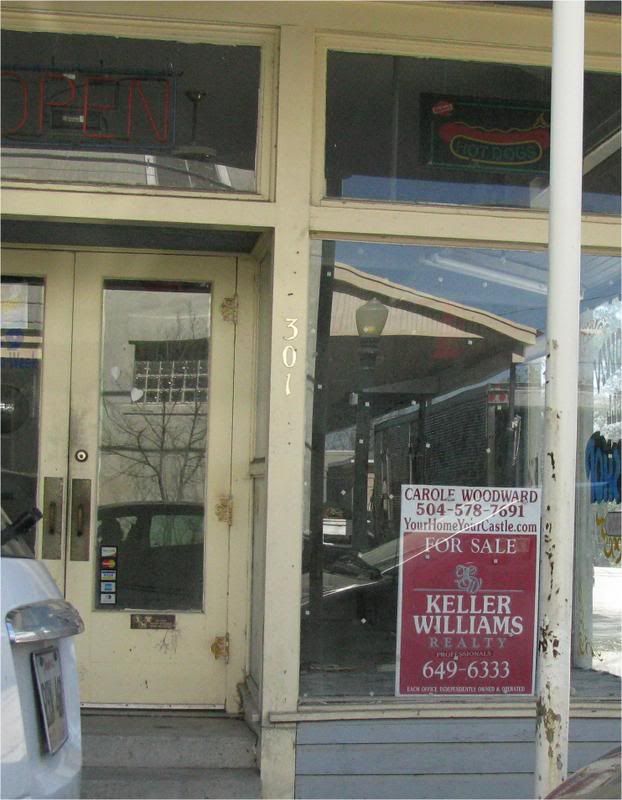
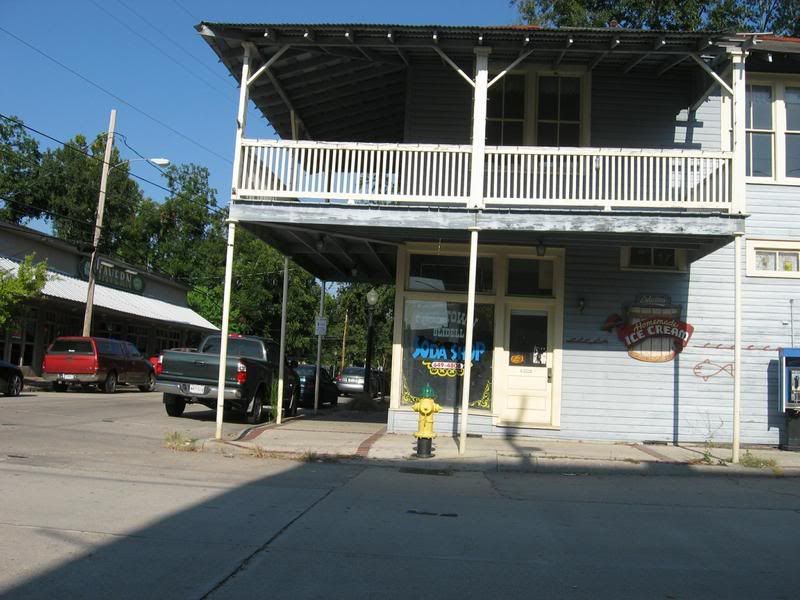
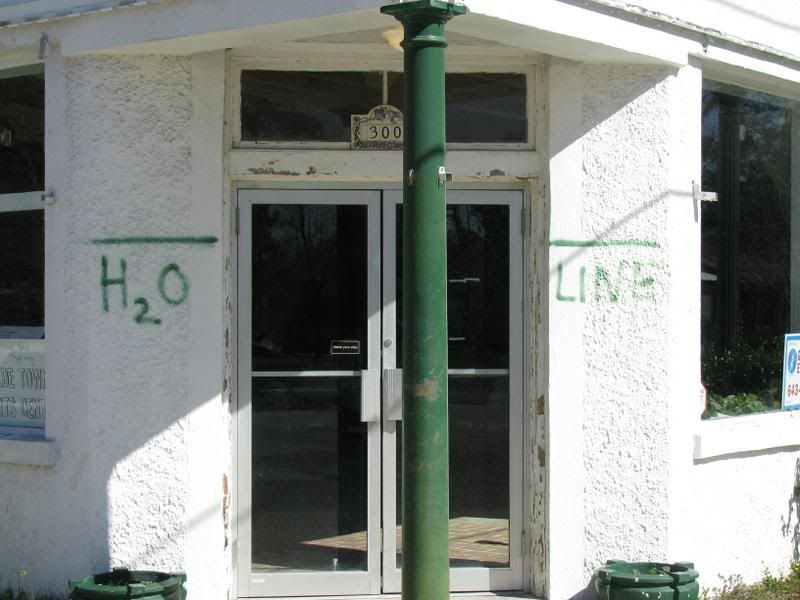
One of many business that never reopened after the storm, the Old Town Soda shop is for sale click on photos for larger versions
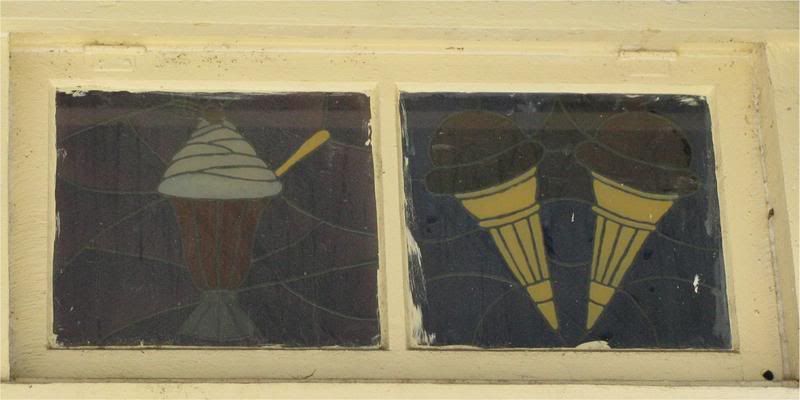
It has some neat ice cream themed stained glass windows....
From Fox News Olde Town Slidell Soda Shop owner Frank Jackson stayed in his house next door on August 29, 2005 and rode out the monster storm. He watched the floodwaters — which covered the town in a massive, tsunami-like wave after Lake Pontchartrain overflowed — engulf the little company he and his wife built from scratch in 1988. He saw Katrina take down friends’ and neighbors’ businesses all around him.
“You just watch it go and move on,” said Jackson standing near the rusty old soda fountain in what’s left of his shop. “You watch your friends’ businesses go, and there’s nothing you can do about it. You figure life will be different.”
And it was different for Jackson and his wife, Carla — totally different. He knew almost right away that the quaint old Slidell Soda Shop was gone for good.
For almost two decades Frank and Carla Jackson, both 53, had poured their hearts and souls into their popular restaurant, which Frank characterizes as an “intense” but fun business.
They hosted about 4,000 birthday parties — Polaroid snapshots of the kids still line the walls — and served homemade ice cream, as well as standard fare like burgers, hotdogs and fountain sodas.
There were no weekends off, and their days were long. But because they ran it together, close to home, they were able to spend time together and with their children.
After Katrina left, the water slowly drained and Frank got his wife and sister-in-law safely out of town. He then set to work hauling out the spoils of his shop. The 800 gallons of souring ice cream and other perishables were the first to go.
“The storm came and took it all, and I just put it out on the curb, little by little,” he said. “I put about $200,000 of junk out on the street.”
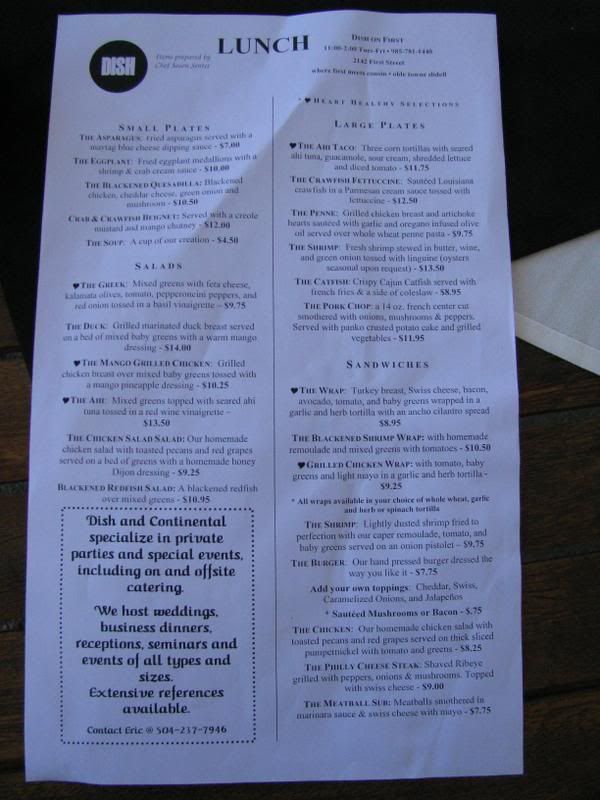
The original intact menus still hang above the interior destruction. A handwritten sign advertising dollar-off banana splits was also untouched by the six-foot floodwaters. Jars of multicolored candies line high shelves; an inflatable, grinning jellybean spins from a ceiling fan.
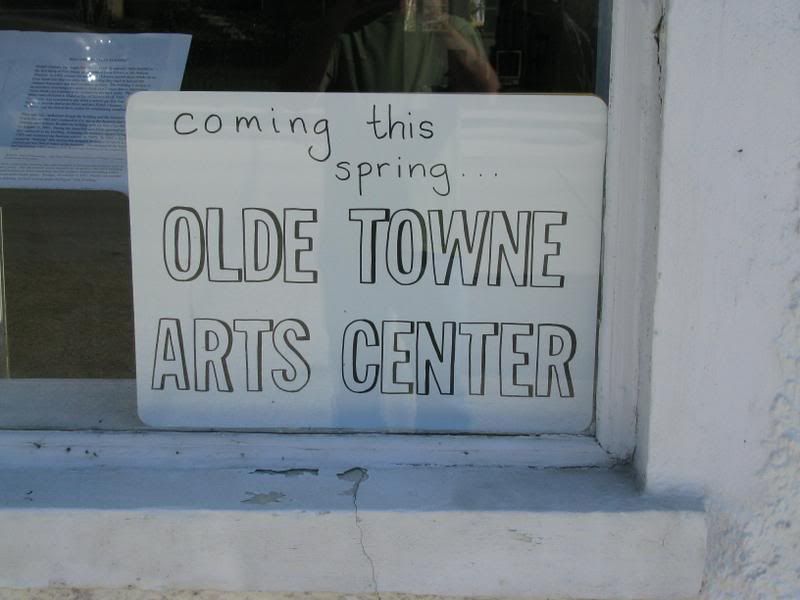
This section of Olde Town is slowly reawakening, 2.5 years post Katrina. The former Slidell Cleaners will soon reopen as an art gallery.
Photo courtesy of Patrisha Walker Thirty months post Katrina and the little town of Buras finally has a watertower again. Some may recall that Buras was the first to feel the storm's power in the Gulf south region
Here's a link to a website of a Buras resident. She says Today, it is shining in the afternoon sun; the golden tower overlooks our new lives post-Katrina. In Buras there is still enormous evidence of the destruction of Aug 29th, 2005. But, there also is enormous evidence of repair and growth. Many, many are coming home to South Plaquemines. In one single morning my husband counted 4 double-wide trailers pass on highway 23 headed south. Plenty are actually building homes. And I do see growth in Buras.
It is good to be home and to have a water-tower!
Her section of town still doesn't have telephone or internet service. They may get it by the end of this month.
Last August, Charles Anderson visited Buras. In his article "Forgotton but Not Gone" he recalls being welcomed into Plaquemine parish:....a burly fisherman approaches me, reaching out one of his beefy hands..."Welcome to the bottom of the world," he booms in a playful, yet gruff voice. "Nobody comes down here. The money stops at the parish line. The government thinks we're not important enough, but we're staying."
Yeah, Forgotton but not gone. That's Buras, Louisiana. Bless them all!!!!
Spring is here at last and to me it is the finest time to enjoy the bounty offered by the Gulf Coast area. Nearly three years post K, this area's denizens have shown the strength and determination within themselves by coming back bigger and better.
Hubby and I are rabid festival-goers and this is prime time for us. It's not just the festivals we enjoy, either.
Last Saturday we ventured down to Napoleon House for lunch. The bruschetta was mouthwatering and I could eat their muffaletta every day.
By the time we finished, it was late afternoon, which proved to be a great time to snap pictures of the classic architecture of the French Quarter.
This Sunday is dubbed "Super Sunday" in NOLA. Wish I could be there to witness the Mardi Gras Indians. Hat Tip to Ashley Truely a treasure, the Indians will strut their stuff, so bring your cameras. Their artistic costumes are like nothing you've ever seen!! My hubby works on Sunday, so I'll be one of those folks enjoying the blogger reports, like Ashley's, on Monday.
About a mile from our house is the Slidell trailhead of the Tammany Trace where bikers, walkers and horseback riders have the opportunity to experience a quiet off-the-road tour of five communities along the northshore of Lake Pontchartrain St. Tammany Parish: Covington, Abita Springs, Mandeville, Lacombe, and Slidell. It's a great way to get away from your hectic week for a few hours. You have the opportunity of biking 40 miles in a few hours. Talk about burning calories!!! We've biked from the Mandeville Trailhead to the Abita Brewpub , had lunch and burned it all off by the end of our roundtrip. Now THAT'S my kind of exercise!!
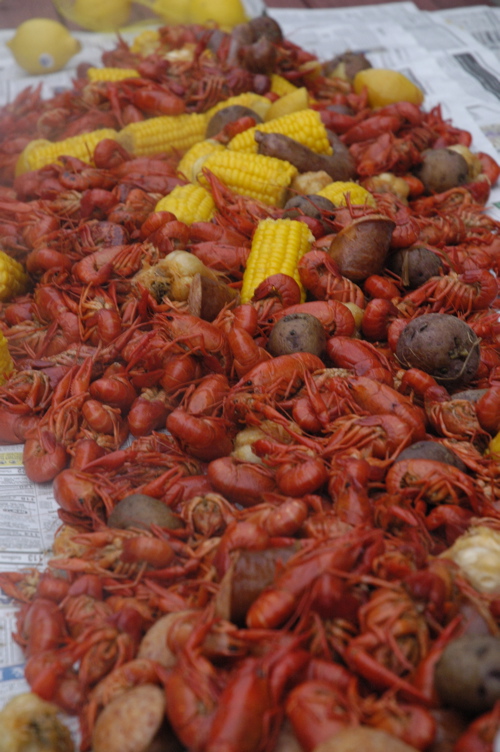
Speaking of mudbugs, April 19th is the date set for the Crawfish Cook-Off - St. Tammany's Biggest Cook-Off Event at Fritchie Park in Slidell. This is the third annual cookoff and it gets bigger and better every year. 50 Teams will compete for the title of "Best Tasting Crawfish". Live Musical Entertainment Lost Bayou Ramblers,Four Unplugged and Top Cats. Money raised benefits the Fund for "End of Life" Care. Over 45,000 lbs. of Crawfish to be boiled. Tickets may be purchased prior to the event at any Northshore Whitney Bank and at the gates the day of the event.
On the weekend of April 5th the Picayune (Mississippi) semi annual street fair happens . This is a really great fair which spans for miles through one of the city's main thoroughfares. There are always plenty of assorted vendors (approximately 250) selling Antiques, Arts & Crafts, Woodwork,Plants,Iron Work, Preserves, Jewelry,Unfinished Furniture and a variety of foods. If you're a people watcher, this is a fair for you!!
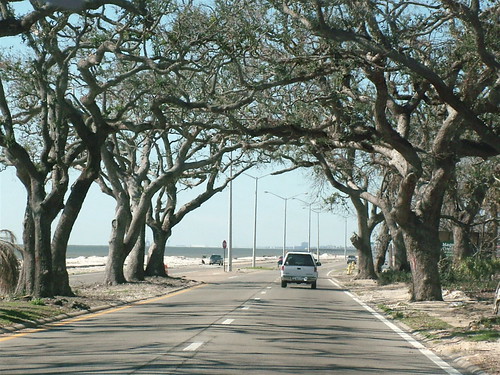
The springtime is a great time to take Highway 90 to the Gulf Coast. While driving towards Biloxi, be sure to look out for the incredible carvings done on oak trees killed by Katrina along the median. Heck, pull over to get a real good look at them. The details are incredible.
Celebrating its 25th anniversary this year, it runs from Friday, April 11 through Sunday, April 13 the FQ Fest offers 250 hours of free entertainment, featuring more than 150 musical performances on fifteen stages throughout the French Quarter. Nearly 60 food and beverage booths located in Jackson Square, Woldenberg Riverfront Park, and elsewhere will make up the “World's Largest Jazz Brunch,” a signature event featuring authentic local cuisine from renowned area restaurants.
The KatrinaRitaville express, a very underreported initiative to tour the country with FEMA trailers to spread the word about criminal enterprise known as FEMA
What they're about (from their website) Several Gulf Coast organizations have purchased two FEMA trailers, which will tour the country over the next year to raise awareness of the ongoing nature of the crisis in the region, and the continued lack of coherent government action to rebuild the region, particularly to rebuild in a manner that meets the needs of its poor and minority residents.
The trailers will be used as a focus for local education and organizing, as a challenge to presidential candidates to make their plans for Gulf Coast reconstruction clear, and as a rallying point to help to mobilize the many thousands who have volunteered their time in work projects to now join in the political efforts to force meaningful government action.
Miloon Kothari of New Delhi, India, the U.N. Human Rights Council's specialist on adequate housing,
and Gay McDougall of Washington, D.C., the U.N. independent expert on minority issues, joined ranks with opponents of the demolitions already under way at the St. Bernard, C.J. Peete and B.W. Cooper complexes.
Although the duo say they released the statement to influence the U.S. Congress, the timing of their comments could have broader influence.
Here's the part that bothers me
"Yes, some people were consulted," Kothari said, "but the fact that people's property was destroyed.......
Federal and local officials reacted strongly last week to the pair's statement. Sen. David Vitter, R-La., called it "theater of the absurd."
HUD said Kothari and McDougall "are misinformed about the state of public housing in New Orleans," adding that the plans to demolish old, hurricane-damaged complexes is part of a wider effort to move to a mixed-income model that will help "minority and low-income Americans . . . live in a socially and economically integrated environment."
Still volunteering in Pearlington and the coast after 30 months, One House at a Time continues building homes for those left without anything in Hancock County, Mississippi.
From their website:
Pearlington lies in the southeast corner of Hancock County, along the Gulf of Mexico. Hurricane Katrina brought widespread devastation to the county with 40 confirmed deaths and millions of dollars of property damage. Nearly 70% of the county’s homes were left uninhabitable. The coastal communities were among the hardest hit areas. Pearlington, a small community of 2,200 people, was particularly devastated, as nearly every home was either completely destroyed or severely damaged. There is no Habitat for Humanity affiliate along this area of the Gulf Coast of Mississippi. Hundreds of residents were living in tents in the aftermath of Katrina. Many have only what they were able to salvage, and in many cases they have nothing at all. As of Feb. 2008, there are dozens of residents STILL living in FEMA trailers.
I began filming this story one month after Katrina came ashore, and I recently returned to the devastated and impoverished town of Pearlington Mississippi. Even though its several miles from the actual coast, the storm surge and the wind brought this place to the brink of its very existence. The waves that came through this town and destroyed everything in their path first had to pass through a few Chemical Plants and Oil refineries out in the Gulf of Mexico. This was not merely sea water that carried these homes away, it was a deadly stew of unknown and unreported toxins. This story follows the recovery efforts of one group that has been based in Pearlington as soon as the roads were clear enough to get in. One House At A TIme is building homes for people of Pearlington who want to stay in the place where they call home. This video tells a little of their story, but anyone who has been there will tell you, there is no video that can be shot that can express the sort of devastation that has occurred on our own soil, to our own people. So go see it for yourself, and bring a hammer.
In addition to turning away trained first responders at gunpoint, FEMA decided to throw out all the band instruments at McDonogh 15 School for the Creative Arts in the French Quarter. Did the school flood? No. Not a drop, but some “mold” was detected on a few of the instruments so out they went. (Cleaning them with bleach would fixed the problem.)........Everyone knows that FEMA knowingly kept thousands of people in trailers contaminated with formaldehyde before they admitted to the problem.
Now it’s been discovered that that just wasn’t enough, so the good folks at FEMA added an extra twist to the trailer scandal.
Used trailers returned to the criminal enterprise (also known as a government agency) were sold to the public. The funds were to be used - 100% of them - to purchase additional emergency housing.
A 2006 Congressional investigation found that the criminal enterprise invested taxpayer dollars in emergency supplies like iPods, beer-making equipment (OK, that could be a legitimate emergency) and designer jackets. Just what every emergency victim needs. Designer duds. Or do you think those ended up in employee closets?
Here's an exerpt from an Op Ed piece that appeared in the New York Times last week about the state of the country's levee system
Last month, a 30-foot section of levee ruptured in Fernley, Nev. While the cause of the breach, which swamped 450 homes and forced dozens of people to evacuate, is unknown, anyone familiar with the drowning of New Orleans by Hurricane Katrina will tell you this: Levees fail.
Indeed, there are more than 100 antiquated earthen berms across the country in danger of collapsing. What happened in Nevada is a harbinger of a much larger problem nationwide.
On the one hand we see an unspeakably corrupt administration. On the other hand courage and generosity that restores one's faith in human nature.
New Orleans in spite of being 80% destroyed by the failure of the federal levee system is coming back strong.
Strong enough to host the NBA All-Star game, to stage over thirty large scale parades during Mardi Gras, to operate its schools, hospitals, roads, hotels and restaurants. The music is back and the incomparable food and culture.
All without the help of the federal government which promised so much and has done so little - and done so much harm.
Three short videos that tell the story:
1. A short art piece which conveys the pain of losing one's home whether in New Orleans or Bagdhad.
2. A rare and little seen video that captured what it means when a levee fails: "From street to roof in three minutes"
3. A vivid recap of how thoroughly the city and its people were abandoned by the government whose job it was to help.
In an initiative that should place at least 120 families into new houses built with energy-efficient features and elevated to a height that should protect them from future floods. Riggio plans to spend $20 million from his family's charitable foundation on the effort.
Residents who participate in the program will receive a new home at no cost, provided they surrender their flooded, uninhabitable house -- or the vacant lot where it once stood -- to Project Home Again, the nonprofit that Riggio spun out of his foundation. The charity will give each family a mortgage equal to the difference between their new and old homes and then steadily forgive the mortgage over a period of five years, after which the family will own the house outright.
A devotee of New Orleans music, Riggio said no flood could wipe out the music, food, culture and "genius" that New Orleans has bequeathed the rest of the country.
Project Home Again will construct single-family homes on 50-foot lots in three sizes: two bedrooms/two baths; three bedrooms/two baths; and four bedrooms/two baths. The homes, which will be offered at no cost to eligible families.
PHA is intended to be a zero overhead operation, with all $20 million going directly to building homes. Eligible applicants must have lived in Gentilly two years prior to the storm and own a home (or former home site) in Gentilly that is uninhabitable due to Hurricane Katrina. They must be willing to swap their old uninhabitable home or site for a new home, and have a family consisting of two to eight individuals. Here are the eligibility requirements
Live Oaks are being planted along the Gulf Coast. It will take many years before their replacements reach the grandeur of the originals, but the new Live oaks being planted will be spread along the Coast from Gulfport to Pearlington.
Deputy Kerry Snaples, 22, of Ponchatoula, died at about 4:20 a.m. Sunday when his motorcycle struck a pickup that was stopped in the westbound lane of U.S. 190 near Covington High School. The Sheriff's Office did not release the deputy's identity Sunday because of difficulty contacting his family.
....the impact knocked the truck into a side ditch. The truck's tail lights were not on, and he says its dark gold and gray paint would have been difficult to see on the dark highway.
Covington Police, who are investigating the case, booked the driver of the pickup, James E. Delancey Jr., 37, of Gulfport, Miss., with vehicular homicide, DWI and driving with a suspended license.
Delancey's blood alcohol level was "several times" the legal limit and he admitted to taking prescription opiates before driving, Covington Police spokesman Lt. Jack West said Sunday.
From an editorial from a Tennessee paper last week, an excerpt:
Now there's no use in beating a dead horse. But then again, you can't really ignore the elephant in the room either. Animal clichés aside, lack of media coverage of the Katrina aftermath is hurting recovery, because no one really knows how bad it is or how to help.
We, as mass media consumers, never got answers to the questions posed in news coverage. The matter was simply washed away.
The irony of this is we, as an editorial board of a newspaper, are complaining about lack of media coverage. Then again, it should be noted that we try to do the best we can, but just simply cannot afford the high-tech and in-depth coverage. But you, the reader, probably already knew that.
At a Massachusettes news site, I ran across this article entitled New Orleans still needs our help ~ In mid January, along with a group from the Boston College Alumni Association, I went to New Orleans as a volunteer to help in the reconstruction of homes damaged by Hurricane Katrina.
What we saw and experienced was far beyond our comprehension. I had expected to find small areas of unfinished homes in need of repairs. Instead, we found that the storm’s devastation is still very much in evidence today. We saw scores of people living in tents under a highway overpass. There were neighborhoods where most of the residents had not returned. There were sites where homes once stood and the only evidence left is the slab of concrete marking its location. In the community where we worked, only 20 to 25 percent of the residents have returned thus far.
Some interesting facts about this area are: · More than 75 percent of the homes were owner occupied;
· In 2004, the unemployment rate hovered near 4 percent while the median income was $36,000;
· Families were working hard — as tradesmen, in the refinery industry and as fisherman;
· The Parish had a large community of retirees — nearly 50 percent of the population, many of whom owned their own homes and lived on fixed incomes;
· 200 people lost their lives in the St. Bernard Parish;
· 100 percent of the homes were officially “uninhabitable”;
The organization we worked with is located in the St. Bernard Parish an area outside of New Orleans encompassing a number of communities. We worked on homes in the town of Chalmette which is next to New Orleans’ Ninth Ward and is arguably one of the hardest hit communities. In the evenings after work, we had the opportunity to have dinner with different people in the community from church groups and education leaders to businessmen, doctors and people who had lost their homes. The stories were gut-wrenching as people described their challenges, their fight for survival and in many instances, personal losses. The amazing thing is, with all their losses, enduring complete financial ruin and having lost everything, not one person that we met ever asked for money or any type of donation.
But universally they asked for one thing. That we go back home and tell their story and that we not forget them. Their plight is no longer front page news and there are times we may not remember their challenge.
This is where the St. Bernard Project comes in. The seeds of the St. Bernard Project were planted in March 2006 by four volunteers who went to St. Bernard Parish to do relief work. After working with people to help them rebuild their homes for a month, they decided to establish the St. Bernard Project. This is a non-profit organization with a mission to provide people with the resources necessary to rebuild their homes. They undertook reconstruction of their first home in August of 2006. Since that time, they have completed over 90 homes and today have nearly 30 more under various stages of construction. They provide construction materials, tools and volunteers to complete their projects. A FEMA trailer cost approximately $70,000. Because all the materials are acquired with donations and all the labor is completed by volunteers and the actual homeowners, the cost for this organization to reconstruct a gutted home is approximately $10,000.00 and takes about eight weeks.
Where do such incredibly dedicated and giving people come from? There are two co-founders of the St. Bernard Project.
Liz McCartney: Liz worked for a community-based nonprofit organization in Washington, DC for the past four years. Prior to that, she taught ESL and middle school for over five years. Liz is a graduate of Boston Collegeand recently received a Master's in Curriculum and Instruction from George Washington University.
Zack Rosenberg: Zack has been a criminal defense attorney in Washington, D.C. for the past three years. Prior to his defense work, he founded Linking Communities for Educational Success (LINK). Before law school he was the development director of Families Forward, a low-income housing and job training program in Washington, D.C. Zack grew up in Belmont and graduated from Belmont High School in 1991 where Zack’s mom still lives. Michael DelRose works with RE/MAX First Realty of Watertown.
St. Bernard Project Accomplishments (Updated 12/05/07) Total Projects 115 Complete home rebuilds 100! Current rebuild projects 33
Total Volunteers 4260 Americorps Volunteers 147 States Represented by Volunteers 52 (with DC and Puerto Rico) Countries Represented by Volunteers 12
Here's a video of St. Bernard created a year after Katrina:
After nearly three years, the headlines about New Orleans contain GOOD news. The city showed the rest of the world that it is an awesome host . As one of the articles said "you can't buy this kind of publicity".
here's a link about the newspaper deleting comments from the hard copy of their paper and online site of all Nagin gun antics, including two letters to the editor. Perhaps they should've thought out the whole Nagin gun issue.
Former NBA great and all-around class act Michael Jordan was in Slidell yesterday to present an extremely generous valentine gift to the Boys & Girls Club of Slidell.
Jordan Brand, a division of Nike, Inc., announced a donation of $500,000 to benefit the Boys & Girls Clubs of Southeast Louisiana's Slidell Unit, to help build a new athletic gymnasium... The donation will go towards the construction of a state-of-the-art gymnasium named after Jordan Brand complete with a professional basketball court, scoreboard and bleachers to be used by the kids of the Boys & Girls Club and other related community events.
The Slidell Boys & Girls Club was damaged in Hurricane Katrina when it took four feet of water inside the facility and required a total rebuild. On a daily basis the club provides education, athletic, and peer support for over 500 children. The rebuilding of the facility serves as a testament to the dedication of many contributions and countless volunteer hours to restore it in honor of the Boys & Girls Club. The Jordan Brand gymnasium will serve as a brick-and-mortar reminder of the contributions and volunteer hours spent rebuilding the facility that has helped and will continue improve the lives of children and families of Slidell.
"The Boys and Girls Clubs of America has been a visible contributor to the families and children of New Orleans, during and post Hurricane Katrina," said Michael Jordan. "Slidell is a community that has been somewhat overlooked in recovery efforts and we are proud to aid with its rebuilding and leave a lasting legacy for the community."
Michael Jordan and some Team Jordan athletes have a special connection to the Boys and Girls Club of America as some were once members and now continue to be involved with the organization in their respective hometowns and communities. Jordan Brand believes that physical activity plays a vital role in building character in youth, and the donation is dedicated to the children of the greater New Orleans area to inspire them to commit themselves to hard work in life and athletics in order to achieve their dreamed goals.
In 2006, Jordan Brand donated $450,000 to Habitat for Humanity to aid in the rebuilding efforts in Louisiana. By auctioning off 21 pairs of Michael Jordan autographed AIR JORDAN shoes to raise the funds, the money helped rebuild homes in the Lower 9th Ward of New Orleans.
Pistolette asks Why is it that people can drone on for hours about the "serious repercussions" of David Vitter getting some illicit nookie, but turn the other way with a "c'est la vie" smirk while Ray Nagin destroys us?
from the "Reel Relief" website , a resident of St. Bernard parish still suffers from his experiences with Katrina: The water came up in 12 minutes. The water came up to our attic. I knew my neighbors, who were 90 and 80-something, had stayed. I didn't see them on the roof, and their house is lower than ours, so I knew they were in the attic. I swam over there, yanked out the vent pipe. As soon as I pulled out that pipe, arms stretched through and grabbed my leg. They had been standing there with their heads tilted back, water up to their necks. I couldn't pull them out through the hole, so I looked around for something to use to make it bigger. There was a 2x4 stuck in a nearby tree. I needed it to break out part of the roof to save them. But when I had to leave them to get the 2x4...
This man is among thousands how still suffer physically and emotionally, almost three years after the storm. Thanks to the many people out there who still volunteer their time, hearts and money to help people like the gentleman above cope with the storm's lingering legacy.
In October I posted about the Brock Project, initiated by the Mayor of New Hyde Park, NY and the Principal of The Road School in the same town, the fine folks there are hoping to raise one million dollars to assist in the rebuilding of Brock Elementary School in Slidell, Louisiana.
Interested in checking out the progress of the rebuilding, and lured outside by the better than excellent weather we had this weekend, hubby & I ventured down to the middle of Slidell, his camera ready to shoot. We got three pictures:
It appears as if work is continuing in bringing life back to Brock Elementary. while not at a breakneck speed, it's safe to say.