Friday, December 21, 2007

Public Housing Debacle

I've been on Christmas break for a few days and have not been checking the local news. Big surprise when I did this morning. I noticed that the fight over the demolision of four New Orleans Housing developments became quite heated yesterday.
It's a shame that things have deteriorated to this level. I believe that it has gone to that level is partly related to "outside agitators". (I see nothing wrong with the term "outside agitators", unlike some folks who think it's a racist term. I think anything can be termed "racist" if it's used in a racist way.)

Anyway, at this time I am torn about what's going on in the city. I've been trying to study up on this story and get a good background on it, but the more I dig, the more small facts are either misrepresented or missing. It's difficult to peel off all the bullshit and hysteria related to these protests to get to the core of the issue.

So far, I've done a history of the projects in questions. Here we go:


ST. BERNARD HOUSING DEVELOPMENT

The St. Bernard Housing Development was the fifth of ten such developments built between 1940 and 1960. Initially, there were 744 units in 74 buildings constructed on 30.9 acres of land. The boundaries were St. Bernard Avenue to Gibson Street and Senate to St. Denis Streets. The architects used the same principles of design of most "housing projects" of the times. Two and three story brick apartment buildings encircled parking lots and playgrounds.

In 1946, a gas explosion on the southside of the development killed seven people and injured 38. Fourteen buildings were demolished.

In the 1950's, The Housing Authority needed to relocate 700 families. Through the 1949 Housing Act, the St. Bernard expanded, adding 720 more units. It is regarded as one of the largest housing developments in New Orleans.

Scattered sites were first introduced to New Orleans in the late 1960s as an alternative to higher concentrated family dwellings. The idea was to have families "scattered" throughout existing neighborhoods to reduce the number of units in one location. One of those sites is the Imperial Scattered Site Housing Development, just to the west of the St. Bernard development. In 1968, the Housing Authority of New Orleans purchased 54 two-bedroom houses and in 1972, bought 200 more.

The St. Bernard Projects are one of the Housing Projects of New Orleans. Located in the city's 7th Ward, the complex was built over a few decades, beginning in the 1940s and has the distinction of being the largest housing project in the city. Like most public housing developments, it was not a very safe complex but by the standards set by other facilities in the city, like the Magnolia Projects, it was one of the city's safer projects until planned closures began and residents of 'rival' housing projects were moved into the St. Bernard.

It has been closed since Hurricane Katrina, much to the dismay of residents and activists.

Survivors Village,
a tent city created by residents of New Orleans housing projects, was established on June 3, 2006 to call attention to what participants and supporters say are violations of the UN International Policy on Internally Displaced Persons.


C.J. PEETE (aka Magnolia)

From 1952 through 1978, the manager was Cleveland Joseph Peete. In the 1980s and 1990s conditions in the projects declined severely. In 1998 demolition of portions of the projects began as part of a Housing Authority of New Orleans (HANO) revitalization plan. There are plans to redevelop the area along the lines of what had been done with the St. Thomas Projects.

By 2005, only the 1955 expansion had been razed. The majority of the remaining buildings were vacant and fenced off, with only a portion still occupied, when the area flooded in the aftermath of Hurricane Katrina (see: Effect of Hurricane Katrina on New Orleans). Redevelopment work has been delayed in the aftermath of the disastrous flood which devastated the majority of the city.

It is one of the most notoriously dangerous housing districts in the United States and ranks even globally. This section of New Orleans has a local crime rate higher than many full municipalities in the US and has a significant influence in New Orleans' extremely high murder rate.

Here's a slide show put together by a C.J. Peete resident
.....…do you really want people to move back here?
(beware the language for the crap rap that plays during the slide show)


B.W. COOPER HOUSING PROJECT (aka Calliope)

The project was built between 1939 and 1941. The original boundaries were South Dorgenois, Erato, Calliope (now Earhart Boulevard) and South Prieur Streets. In 1941 rents ran from $8.25 a month for a one bedroom apartment to $22.00 a month for a three bedroom.

There are 690 apartments in the original development. In 1949, a gymnasium was added at Broad and Calliope Streets.

In 1954, a twelve block expansion added 860 new units. The expansion pushed the western boundary of the Calliope back two blocks from Erato Street to Melpomene Avenue (now Martin Luther King, Jr. Boulevard).

In May 1981, the Calliope was renamed the B. W. Cooper Apartments. Mr. Cooper worked for the Housing Authority of New Orleans for 33 years and served on several civic and social organizations until his death in 1974.

The Calliope Projects (or simply Calliope to the locals) are among the most notorious in Uptown New Orleans and the United States along with the Magnolia Projects. The drug trade and subsequent violence from it were two of the primary reasons New Orleans was nicknamed the "Murder Capital of the U.S."

A popular nickname for these projects is "CP-3" meaning "Calliope Projects--Third Ward".

Notable residents have included Master P and brothers C-Murder and Silkk The Shocker, as well as the Neville Brothers.

Most of Calliope is closed due to damage from Hurricane Katrina. As of January 2007, a small section of Calliope has been reopened to residents.
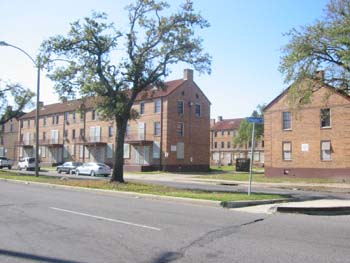


LAFITTE HOUSING PROJECT
In 1941, the Lafitte 896-unit housing development was completed. Lafitte was to house African American tenants while the nearby Iberville development accommodated Caucasian tenants.

Low-income families, including residents of the Lafitte Housing project, will be able to return to new homes as part of a $350 million development project to revitalize the predominantly African-American Tremé neighborhood. The construction of 1,500 new homes on the site of the Lafitte Housing Project and scattered throughout Tremé will preserve all 900 subsidized housing units that existed pre-Katrina, while renovating and building an additional 600 vacant properties as affordable homes.


Here's a link to more New Orleans Housing Projects photos

Appropriations


Details on the Omnibus Appropriations Bill with $142M Specifically for La.


The omnibus appropriations bill contains key funding for Louisiana that will help us recover from the 2005 hurricanes and boost our economy by fueling infrastructure projects all over the state.

The bill now must return to the House of Representatives for final consideration before being sent to President Bush's desk.

Something Positive (for a change)

Katrina wrought so much destruction and pain. But there are some things related to the storm's aftermath which may have a positive affect on the area and hopefully more wide spread areas in the near future.

One such project is the grassroots efforts started by an non profit organization in the Slidell area called Bio Liberty .

The brainchild of US Vet Gordon Soderberg of Slidell, Bio Liberty aims to help rebuild the Gulf Coast.....and use recycled materials and renewable energy techniques through the following aims:

1. Market the use of bio diesel that we use in our vehicles and equipment.
2. Market our lot clearing and tilt wall construction services.
3. To demonstrate a sustainable business model
4. Provide jobs for Veterans of the US Military.


Located in the heart of the Bayou Liberty area in Slidell on the same land used by hundreds of volunteers from the Bayou Liberty Relief Organization , Bio Liberty has already manufactured 500 gallons of "Gator Grease ®". It's used in their tractor, bobcat, stump grinder, trucks, a media buse, and a Volkswagon TDI. Gator Grease powers the equipment used to run the machines that perform lot cleaning services in Slidell and New Orleans. All drivers and operators have reported increased fuel economy, horsepower, and engine response using the Gator Grease. To date, Bio Liberty has cleared 50-60 lots in the Lower 9th Ward.

Gator Grease is made from used cooking oil from Slidell restaurants Southside Cafe , Vera's Restuarant and the Red Fish Trading Company.

Here's a link to a video that tells the whole story of Bio Liberty. It gives one a good feeling to know there are people out there who are actively pursuing to make this area come back better.

Thursday, December 13, 2007

FEMA Trailer Testing to begin


The Centers for Disease Control and Prevention will begin testing Dec. 21 for formaldehyde in a sampling of trailers FEMA
provided for victims of Hurricanes Katrina and Rita, FEMA and the CDC announced today.

The testing is scheduled to take 35 days, when results will be shared with residents. A final report will be made public in mid-May, the agencies said.

Dr. Henry Falk, director of CDC's Coordinating Center for Environmental Health and Injury Prevention, said 500 trailers will be tested. He said that number was chosen because it allows a representative sample of 11 types of trailers by different manufacturers. Scientists, accompanied by FEMA officials, will go to trailers in Louisiana and Mississippi proportional to the number of occupied trailers in each state.

There are about 46,000 families in FEMA travel trailers and mobile homes across the Gulf Coast.


It's about freaking time, y'all.

August '06 from The homeland stupidity website
In Mississippi alone, FEMA has received 46 complaints from people who say they have been affected by symptoms of formaldehyde exposure, including eye, nose, and throat irritation, nausea and breathing difficulties. According to the Environmental Protection Agency, formaldehyde has been found to cause cancer in rats and may cause cancer in humans.

The Sierra Club conducted tests of 31 FEMA travel trailers and found that 29 of them had unsafe levels of formaldehyde, according to a report (PDF) published on the group’s Web site.


A tragic story about the affect of this toxic substance's tragic affects were detailed in a Gambit story in July.

Indeed, the story of toxic levels of formaldehyde in the 120,000 trailers that FEMA supplied to Katrina and Rita evacuees -- and the agency's cover-up of the crisis -- is still unfolding. At a minimum, more than 5,000 internal emails, many made public on July 19 by the House Committee on Oversight and Government, reveal what committee chairman Rep. Henry Waxman (D-Calif.) calls "an official policy of premeditated ignorance."

CBS news received an envelope stuffed with documents from the FEMA.
What they found was quite interesting:
a standard part of the job description package for most federal jobs..... entitled "FEMA Job Hazard Analysis" and lists, in helpful chart form, the activities involved in the position. The position is Logistics Material Specialist, Trailer In-Bound Inspection (the guy or gal who inspects a brand-new trailer before it is sent off to a needy family in the Gulf).

Under the "Physical Hazard" for those entering a new trailer it says, "Formaldehyde off gassing..."

The potential injury: Cancer.


From Ellathebella over at reelrelief dot com
I spent the weekend working in Hancock County. While researching air quality issues, with the help of two stalwart volunteers, I spent about sixteen hours over two days in FEMA trailers, a FEMA mobile home, a newly constructed home and a MEMA cottage. Before the second day of work was over, we were all suffering from nausea, headaches, bloodshot, puffy eyes and wheezing in our lungs. Having left that environment, we are all feeling better. We had the option to leave for more healthful housing, thanks to the generous folks at St. Rose Outreach and Recovery and D'Iberville Volunteers Foundation. Even if money were not an issue, which it is, there are not enough buildings for everyone on the Gulf Coast to leave the trailers.

If we felt that sick after two days, how must it feel to live in that environment day after day after day?

It has been 27 months since Katrina hit. I would challenge anyone on Capitol Hill to spend 27 days, let alone 27 months, living in this uncertain, unhealthful environment and say that enough money has been spent on Gulf Coast recovery.


FEMA, acting "responsibly" issued this press release in July of 2007


From the Sea Coast Echo website

A Bay St. Louis resident who worked in conjunction with the Federal Emergency Management Agency following Hurricane Katrina alleges the embattled agency knew of potentially dangerous levels of formaldehyde in trailers in December 2005 and the death of a Diamondhead newborn may be connected.
A congressional hearing held last month have resulted in changes to many of FEMA's procedures, including distributing formaldehyde information, revising guidelines of swapping trailers to temporally halting sales and deployment of travel trailers.

From Food Music Justice dot com
Quotes from a 7/20/07 New York Times article about formaldehyde-laden FEMA trailers provided to evacuees :

“We were not formaldehyde experts.”
- R. David Paulison. FEMA Adminstrator.

“Do not initiate any testing until we give the O.K. Once you get results the clock starts running on our duty to respond to them.”
- Unnamed FEMA lawyer sent this e-mail in response to concerns expressed by field staff about toxic levels of formaldehyde reported in FEMA trailers.


How do these bastards sleep at night?

Wednesday, December 12, 2007

Scuzzbucket of the week

I was reading the article at nola dot com about the two bodies which were discovered a few miles apart on Interstate 12 in western St. Tammany Parish. The victims were of Hispanic descent. After reading the article, I stumbled into the 'comments' section where this einstein posted


I find it interesting how things have changed since the large influx of non-locals to St. Tammany. You may call me a racist or a bigot, but it is a FACT of life in our society that these people are bringing violence and crime to our area. It is crimes like these that I thought only occured in the East (New York/New Jersey) and West (California/Arizona) of our nation. It is a shame that we cannot preserve our community and heritage since Katrina. There are so many out here that complain about who we were and how we need to keep South Louisiana as she was, but there is little action. We really need to get out act together, stop arguing over who lives where and just make sure that our community does not implode before we have time to rebuild.


What a pinhead idiot this person is.

Happy Story (for a change)

December sucks. Too many things to do, so little time. While looking around for something to smile about in the midst of so much bad news, I came across this at the Katrina film dot com website


Thanks to Charles London for this ray of sunshine for today.

Tuesday, December 11, 2007

Why I love New Orleans


One of a thousand reasons.

Cliff on Brad


Cliff's take on what Brad Pitt is doing down in the 9th Ward


While “black leaders” all over the country sit by their television and wait for the next Don Imus or Jena Six to jump off.

Guess who’s down here on the ground actually helping poor black people rebuild their homes?

Baghdad on the Bayou - Part II

Excerpts from part two of an interview with Tab Benoit about Louisiana Wetlands.

I posted about part one last week

“Right after the hurricane, they were digging new canals. I saw, I was out there in my boat. Here the world just saw us flood because of this [Katrina], and we did get introduced to the fact that the wetlands are our real protection, and here oil companies are right in here instantly digging again. It’s wide open. It’s a gold rush down here. This town [Houma] is, probably after Katrina, another 30 or 40 thousand people. This town was 80,000 before Katrina, and now it’s way beyond. All of that is oil. That’s the only real industry out here.

“But then again my family will gladly move out of here. They don’t have any ties here, not like me. I love this place. I understand the importance of Louisiana, for the United States to survive, for the globe to survive. You hear all about this global warming, and you look at all the stuff that supposedly causes it, and the stuff that could be fixing it. Everybody knows that the delta of a river, that those lush forests of swamps and trees are like natural filters, and oxygen makers. And we just killed a huge amount of it. We killed the third largest river on the planet’s delta. We killed one of our big atmosphere scrubbers. It doesn’t take a genius to figure out that maybe we should pay more attention to the delta of the Mississippi river.”

“As soon as I started being a professional musician I felt this is the right place. Just keep going. It’s led me to everything that I’ve done. Like talking to you right now. Little did I know that my area would need the most help out of any area in this entire country. But there you go. There’s gotta be a reason why I’m here, why I know what I know, why I’ve seen what I’ve seen, and everything that I did before was a huge part of getting me involved in wetlands restoration. I saw it from the air, day to day, I would come in and talk about it and people would think that’s never going to happen in my lifetime. Every day I’m watching stuff wash away. Yes, this is going to happen in our lifetime. Learning it from the air, watching it from a bird’s eye view, it’s so much easier to see. All your questions are answered in a matter of minutes.”

Monday, December 10, 2007

December

an interesting post comparing
December activities in New Orleans versus Wisconson.


Yeah, you right.

The East


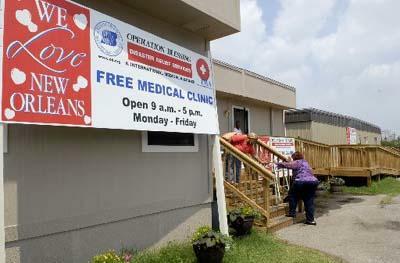
New Orleans East clinic closing.


Opened 18 months after the storm, a New Orleans East Clinic, operated by
Operation Blessing International .
must close in less than a month.

From the above link
Operation Blessing, the charity that launched the clinic after Katrina and raised thousands of dollars to support its operations, has exhausted the stash of private donations that came pouring in after the storm.
The closing threatened to strand thousands of uninsured patients in eastern New Orleans without health care in their neighborhood, but the city Health Department - aware for some time that the clinic would close - has made provisions to turn an obstetrics clinic on Read Boulevard into a full-service primary care office by January.

A lot of blame has been pointed at the federal government since Katrina, and rightly so. But the above statement makes it clear that
Ray "Chocolate City" Nagin has not been on the job since his re-election; a victory fueled by the diaspora of Katrina victims not living in the city.
Ray Nagin…..here's a guy who can't remember if he
voted in the last three elections
. The voting records show he didn't, but he claims he did. Whom would YOU believe?

New Orleans East has long been the "bastard step child" of the Big Easy.
I work in the industrial section in The East, and the main thoroughfare - Old Gentilly Road - has been in dire need repairs since long before the storm.
The New Orleans city government has been contacted numerous times regarding the road repairs and chooses to ignore them.

Heartfelt thanks goes out to Operation Blessing and all who've donated to them. You can be assured that your money has been put to the
best use. Let's hope that the city of New Orleans steps up to the plate and opens that long closed hospital in timely fashion to help the people
in The East.

Newsom trolls drumpf